PARODY / MEDIA CRITICISM / TROUBLE IN PARADISE
Trouble in Paradise: Who Was Fact-Checking Whom?
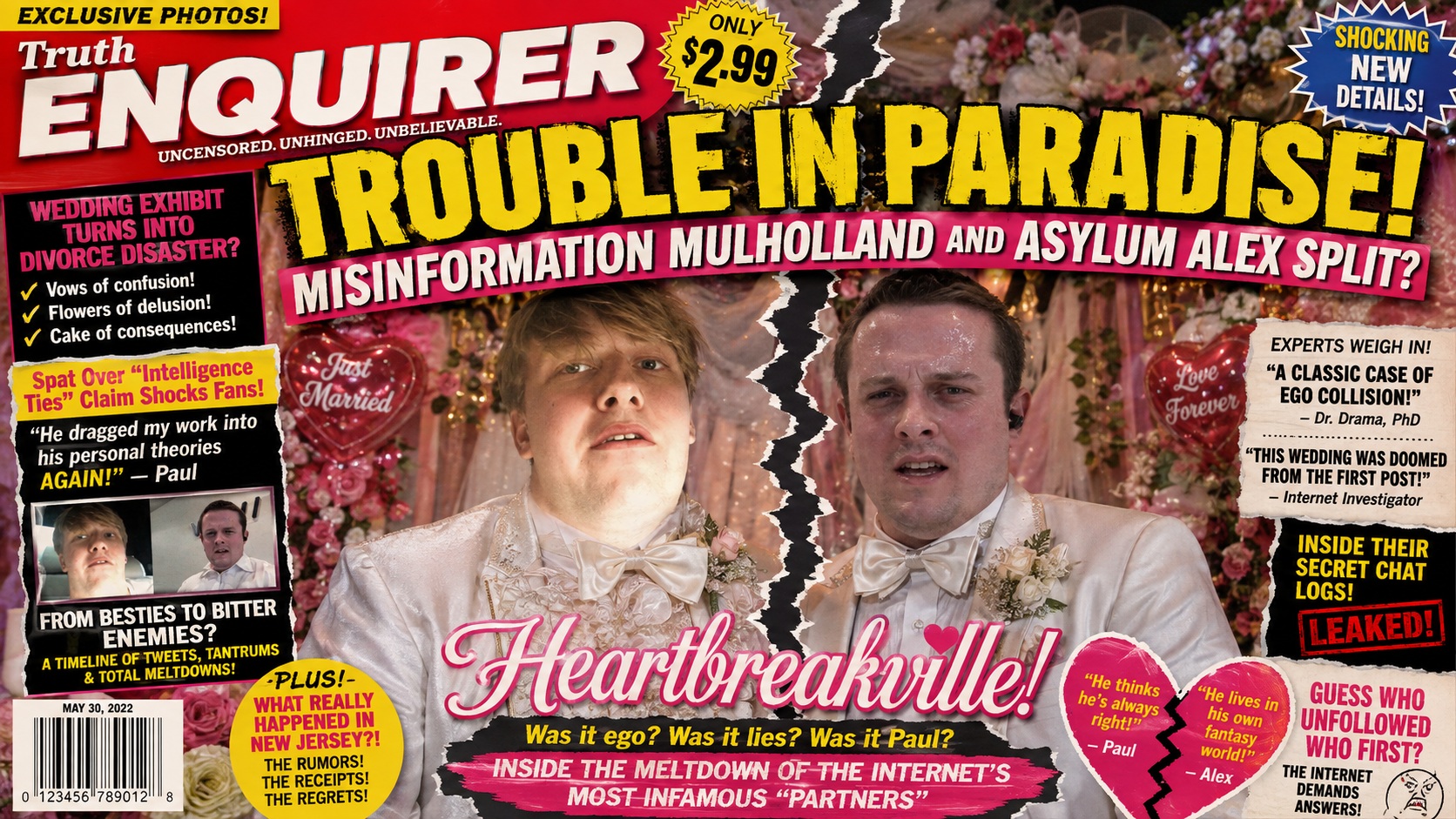
Misinformation Mulholland and Conspiracy Alex appear to have reached Heartbreakville. But underneath the parody is a serious question: if these two were exchanging research, who was actually checking the claims before they reached the public?
Every great romance eventually reaches the difficult questions.
Who forgot the anniversary?
Who left the dishes in the sink?
And, in the case of the internet’s strangest apparent research marriage:
Who exactly was fact-checking whom?
That question became considerably harder to ignore after journalist Paul Mulholland publicly distanced his reporting from theories being circulated by Alex Barber.
The breakup, metaphorically speaking, appears to have gone well beyond a minor disagreement over whose turn it was to take out the misinformation.
Welcome to Heartbreakville
The parody practically writes itself.
One moment, two internet researchers appear to be moving through the same information ecosystem, discussing the same company and seemingly orbiting the same allegations.
The next, Mulholland is appearing in Reddit threads explaining that some of the most sensational claims being associated with his reporting are not actually supported by his reporting.
The Honeymoon Ends With a Fact Check
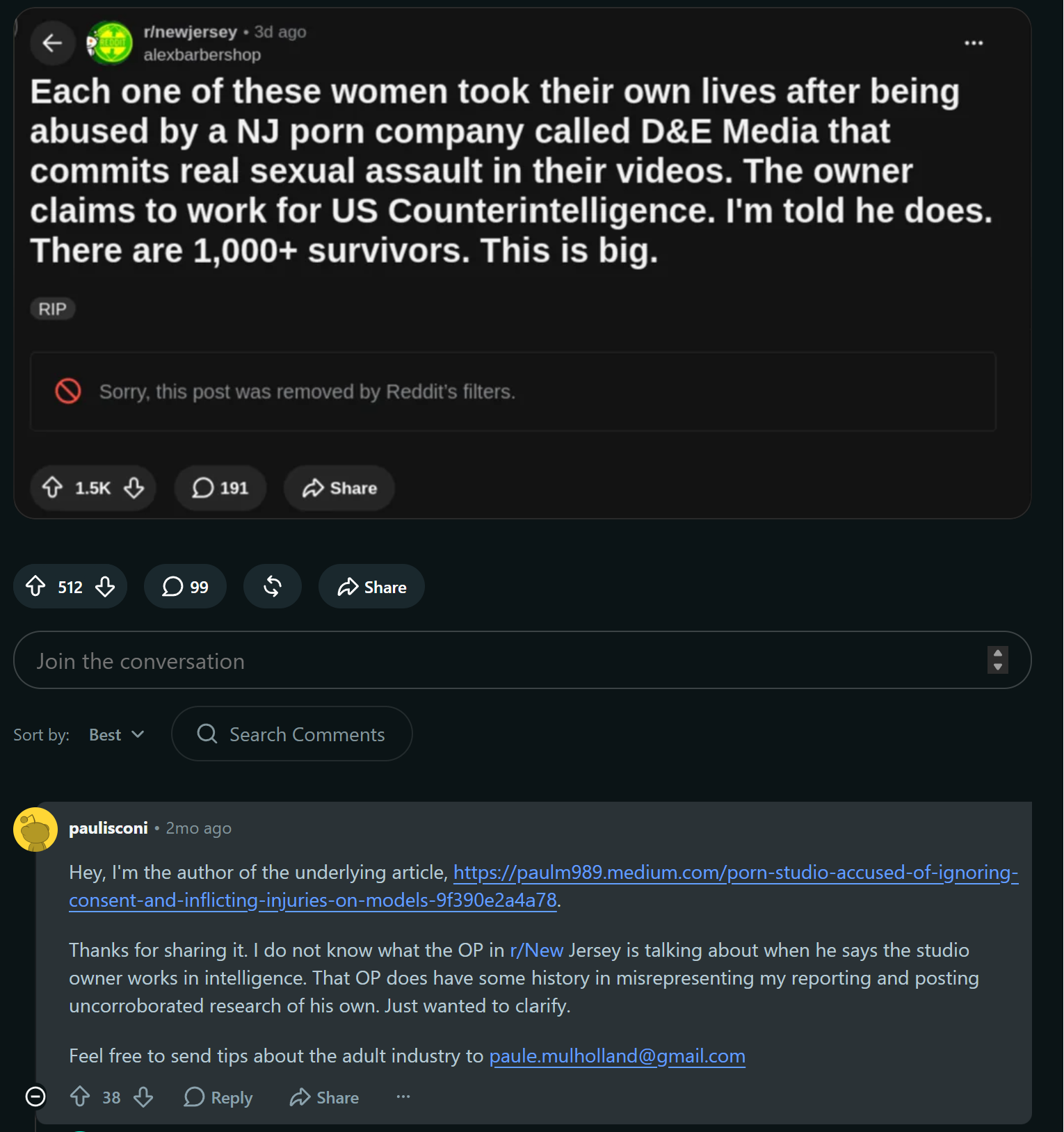
One of the biggest claims circulated in connection with the D&E Media story was that the company’s owner supposedly worked in American intelligence.
That is not a small embellishment.
It fundamentally changes the story.
A dispute involving an adult-content company becomes, almost instantly, a supposed intelligence scandal involving secret government connections, protection and conspiracy.
Except Mulholland himself eventually stepped into the discussion and said there was no evidence that the company owner worked, or had ever worked, in government intelligence.
AWKWARD WEDDING-VOW UPDATE
“There is no evidence that the studio owner works or has ever worked in government intelligence.”
Paul Mulholland, responding publicly on Reddit
That is the point at which the funny fake wedding cake begins sliding off the table.
So Where Were the Ideas Coming From?
This is where the story becomes more interesting than the parody.
If Barber was functioning as a research partner, source, collaborator or informal information conduit for Mulholland at any point, then readers are entitled to ask a very basic question:
What information came from Alex, and what did Mulholland independently verify before using it?
That question matters because Mulholland later described Barber as having a habit of associating personal theories with his work.
In another Reddit response, Mulholland reportedly characterized dealing with those associations as an unwanted errand and said the situation had been “a nuisance for a long time.”
The obvious follow-up is not merely whether Mulholland disagrees with Barber now.
The more important question is when Mulholland began recognizing that problem.
THE QUESTION MULHOLLAND SHOULD ANSWER
If Barber had been providing information, leads, theories, documents or research before this public distancing occurred, which parts of that material were independently verified, and which parts were rejected?
“Trust Me, I Checked With the Other Guy” Is Not a System
Professional journalism is supposed to have a boring part.
The boring part is what makes it journalism.
Documents are checked.
Sources are challenged.
Numbers are traced back to their origins.
Sensational claims require stronger evidence than ordinary ones.
And most importantly, one researcher does not become another researcher’s fact-checker merely because they happen to agree with each other.
That creates a circular verification problem:
Alex tells Paul.
Paul’s reporting gives the subject credibility.
Alex points back to Paul’s work as validation.
And suddenly nobody remembers where the original claim came from.
That is precisely the kind of informational feedback loop a professional reporting process is supposed to prevent.
The Public Breakup Creates a New Problem
Mulholland’s decision to publicly reject unsupported theories is a good thing insofar as it clarifies what his reporting does and does not establish.
But the clarification creates another question.
If the problem had existed “for a long time,” then how much information travelled between these two worlds before the boundary was finally drawn publicly?
That does not prove that Mulholland published false information supplied by Barber.
There is not enough evidence presented here to make that claim.
But it absolutely creates a legitimate transparency question.
THE RECEIPTS READERS ACTUALLY NEED
What information did Barber provide?
What information was independently corroborated?
What claims were rejected?
Were any published claims originally suggested by Barber?
And did Mulholland ever rely on Barber as a source before publicly declaring his theories unreliable?
Can Readers Trust Mulholland After This?
The answer cannot responsibly be reduced to either yes or no based on these screenshots alone.
What they do establish is that Mulholland himself believed a meaningful distinction needed to be drawn between his reporting and Barber’s personal theories.
That makes transparency more important, not less.
If Mulholland wants readers to trust that distinction, the strongest possible response would be to explain the research chain clearly.
Which sources were his?
Which leads came from Barber?
Which allegations were independently verified?
And which claims were merely Barber’s theories and never part of Mulholland’s reporting at all?
The Research Marriage Needs a Prenup
This is where our fake tabloid marriage metaphor becomes unexpectedly useful.
Research partnerships need boundaries.
Who owns which claim?
Who verified it?
Who merely suggested it?
And when the relationship falls apart, can readers still tell which intellectual furniture belonged to whom?
When two people publicly disagree about what counts as evidence, readers need to know whose evidence made it into the reporting.
The Bottom Line
The joke is that Misinformation Mulholland and Conspiracy Alex have arrived in Heartbreakville, their beautiful research marriage torn apart by a giant jagged crack labelled FACT CHECKING.
The serious issue underneath it is much simpler.
A journalist publicly distancing himself from another person’s unsupported theories is useful.
But if that person previously supplied research, leads or information, the public deserves enough transparency to determine where one person’s work ended and the other’s began.
Before readers are asked to trust the happy couple’s old reporting, somebody needs to explain who brought what to the marriage.
Because right now, nobody knows who was checking the wedding vows.