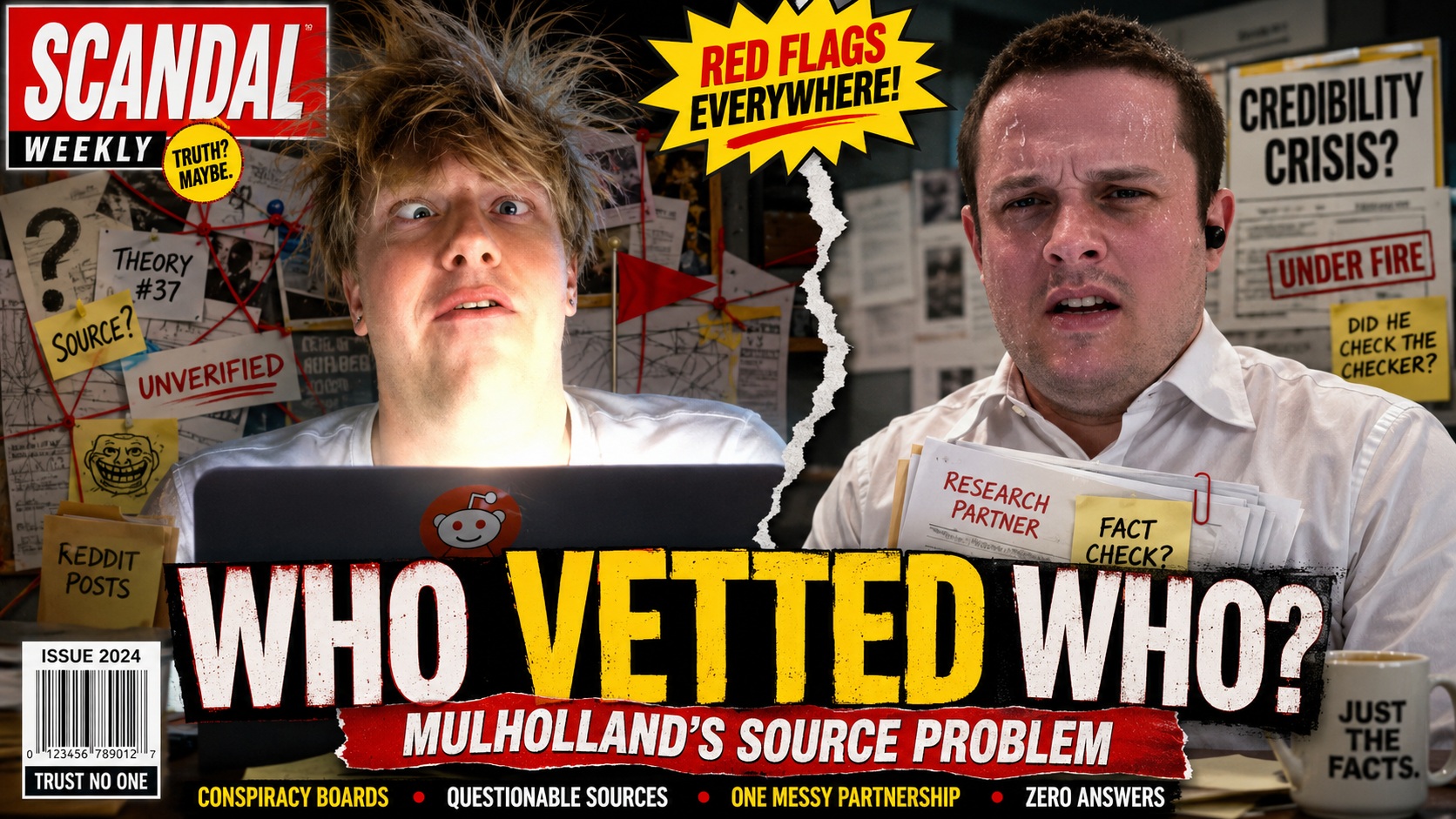
THE SOURCE-VETTING PROBLEM
Did Mulholland Vet His Own Research Partner?
Before a journalist asks readers to trust his investigation, there is a more basic question: how carefully did he investigate the person helping him investigate everyone else?
Professional journalism is built around skepticism.
You question the company.
You question the witnesses.
You question documents, numbers, anonymous tips and conveniently dramatic stories.
And presumably, before you describe somebody as your research partner, you question them too.
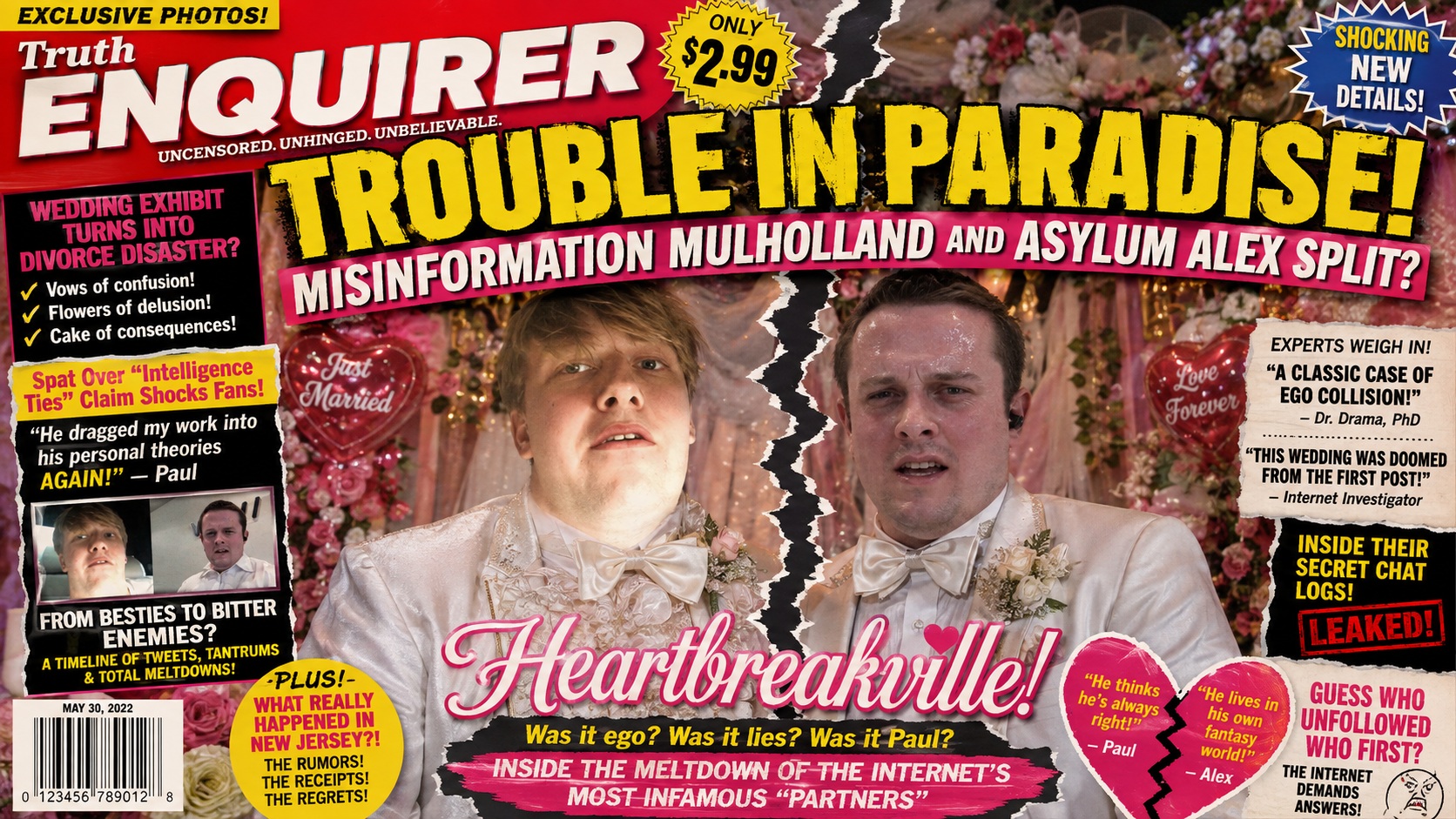
That is what makes Paul Mulholland’s relationship with Alex Barber increasingly difficult to understand.
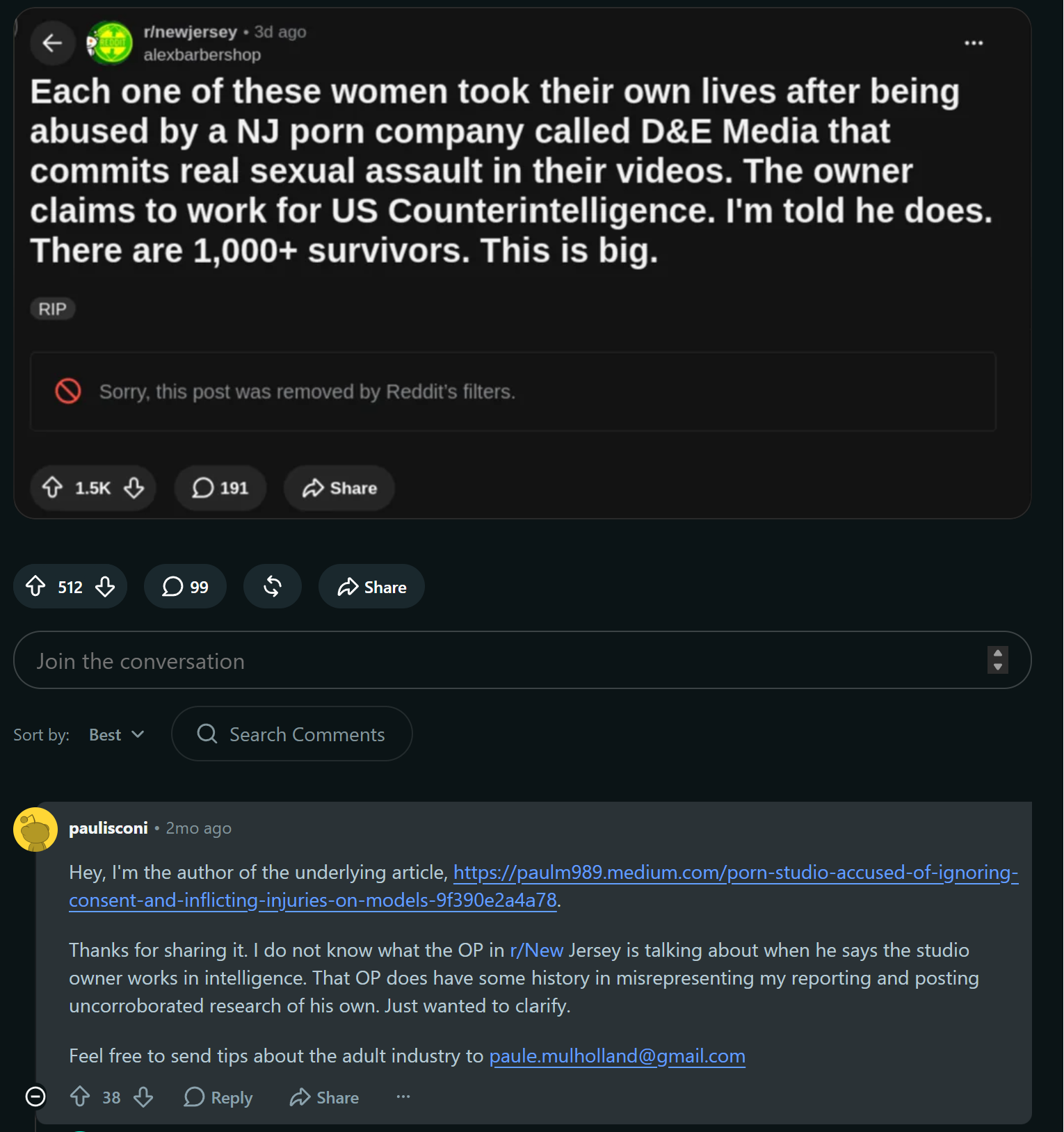
Mulholland has subsequently gone onto Reddit to publicly distance his journalism from Barber’s personal theories. He has complained about unsupported claims becoming associated with his work and described the problem as something that had been going on for a long time.
But that creates a question Mulholland has not escaped simply by disavowing the theories afterward:
Why did a journalist choose this person as a research partner in the first place?
You Don’t Need a Background Check. Reddit Was Right There.
This is not an argument that somebody becomes an unreliable source simply because they have eccentric opinions, strong politics or unusual interests.
Nor can anyone diagnose another person’s mental health by scrolling through Reddit posts.
That is not the issue.
The issue is evidentiary judgment.
What does a prospective research partner publicly demonstrate about the way he distinguishes evidence from suspicion?
How quickly does he move from a question to an accusation?
Does he habitually entertain enormous theories from limited information?
And does his public writing suggest that claims are being carefully corroborated before they are presented to other people?
Those are absolutely relevant questions when selecting somebody to help investigate serious allegations involving real people and real businesses.
The Public Posting History Was Not Exactly Hidden
Barber’s Reddit account publicly identifies him, among other things, as an “OSINT Investigator.”
That makes the public record particularly relevant. OSINT — open-source intelligence — is supposed to depend upon sourcing, corroboration, provenance and distinguishing what can actually be established from what merely seems possible.
Yet Barber’s public posting history contains repeated examples of extraordinarily speculative framing.
THE PUBLIC RECORD
One post asked who actually runs Facebook and proposed the possibility that the platform was being used primarily as a mafia organizational tool.
An older Uber-related post openly wondered how much moderators had supposedly been paid to shut down discussion, invoking an alleged “bribe” in the headline.
Another post announced “REAL ADDRESS FOUND” while investigating who was supposedly behind Chime.
Still others promoted material under dramatic titles such as “LA Union Station’s Dark Secret.”
Any single one of these could have an innocent explanation.
A provocative Reddit headline is not proof that its author fabricated anything.
But that misses the professional question.
A journalist selecting a research partner does not need proof that the person is unreliable before asking whether his claims require unusually aggressive verification.
This Is What Vetting Is For
Source vetting does not mean asking whether somebody seems nice.
It means understanding how that person knows what he claims to know.
If Barber brought Mulholland an allegation, what happened next?
Was Barber himself the source?
Was he summarizing something somebody else told him?
Was there a document?
Was the document authentic?
Was there a second independent source?
Could the allegation be disproved?
And perhaps most importantly: did Mulholland recognize Barber’s tendency toward expansive theories before entering into a research relationship with him?
THE VETTING QUESTION
A journalist did not need secret information about Barber to evaluate his research habits. Barber had years of public posts sitting under his own username.
Then Came the Intelligence Claim
The importance of that vetting became painfully obvious later.
Barber circulated the extraordinary claim that the owner of D&E Media worked for U.S. counterintelligence.
Mulholland eventually appeared publicly and said there was no evidence that the studio owner worked or had ever worked in government intelligence.
Mulholland also complained that the poster had a habit of associating unsupported personal theories with his journalism.
That clarification was important.
But it also transformed Barber’s earlier public history from trivia into a legitimate question about Mulholland’s editorial judgment.
THE PROBLEM
If Mulholland eventually concluded that Barber habitually attached unsupported theories to his work, readers deserve to know when he reached that conclusion — and what information Barber had already supplied before he reached it.
The Problem Isn’t Alex’s Opinions. It’s Paul’s Quality Control.
It would be easy to turn this into an article simply mocking Barber’s Reddit history.
That would actually let Mulholland off too easily.
Barber is responsible for Barber’s claims.
But Mulholland is responsible for Mulholland’s journalism.
If you voluntarily bring another person into an investigation as a research partner, you assume responsibility for establishing what role that person’s information will play.
That means verifying his leads rather than trusting his confidence.
It means tracing allegations to original sources.
And it means recognizing whether somebody has a public tendency to leap toward hidden explanations and compensating for that tendency with even stricter corroboration.
A research partner can supply a lead.
A research partner cannot be the verification for his own lead.
And enthusiasm is not corroboration.
What Did Mulholland Know, and When?
This is the question that now deserves an answer.
Mulholland has publicly indicated that Barber associating personal theories with his work had become a recurring problem.
If that behavior had been happening for a long time, then when did Mulholland first notice it?
Before Barber became a research partner?
During the partnership?
Only after the intelligence story began spreading publicly?
And once Mulholland recognized the issue, did he go back through information Barber had previously supplied and re-verify it?
FIVE QUESTIONS FOR MULHOLLAND
1. What vetting did you perform before treating Barber as a research partner?
2. Were you aware of his public Reddit history before working with him?
3. What information or leads did Barber provide for your reporting?
4. Which of those claims were independently corroborated without relying on Barber?
5. After concluding that Barber was attaching unsupported theories to your work, did you re-review information he had previously supplied?
A Professional Journalist Should Have Reservations
Would Barber’s Reddit history automatically disqualify him from ever providing useful information?
No.
Even unreliable sources can occasionally provide genuine documents or legitimate leads.
But a professional journalist reviewing this public record should absolutely have had reservations about relying on Barber without unusually careful independent verification.
That is not an insult.
That is literally the job.
The more extraordinary your source’s theories become, the more ordinary your verification process needs to be: documents, corroboration, attribution and proof.
You Can’t Disavow the Source and Ignore the Sourcing
Mulholland’s later public distancing raises a credibility issue precisely because he cannot have it both ways.
If Barber’s personal theories were sufficiently unreliable that Mulholland needed to publicly separate them from his journalism, then readers deserve an explanation of how Barber’s earlier research was handled.
That does not mean every previous Mulholland article is suddenly false.
It means the chain of verification matters.
Mulholland can resolve much of the uncertainty simply by being transparent.
What came from Barber?
What came from independent sources?
What was verified?
What was rejected?
And what, if anything, was reconsidered once he concluded that Barber had a recurring problem attaching unsupported theories to his work?
The Bottom Line
A journalist cannot control every strange thing an acquaintance, source or research partner says online.
He can control whom he chooses to work with.
He can control how their information is verified.
And he can explain the safeguards he used when that relationship later produces exactly the kind of unsupported claims source vetting is supposed to catch.
Before Paul Mulholland asks readers to trust the investigation, there is one piece of research he should probably show us.
The research he did on his own research partner.